




According to data from China Customs, China exported 72,291.12 tons of insecticide formulations in January and February 2025, marking a 26.99% increase year-on-year in actual volume. Despite this significant growth, export revenue reached USD 3.07 billion, up only 12.21%, reflecting a notable 11.64% drop in average unit prices.
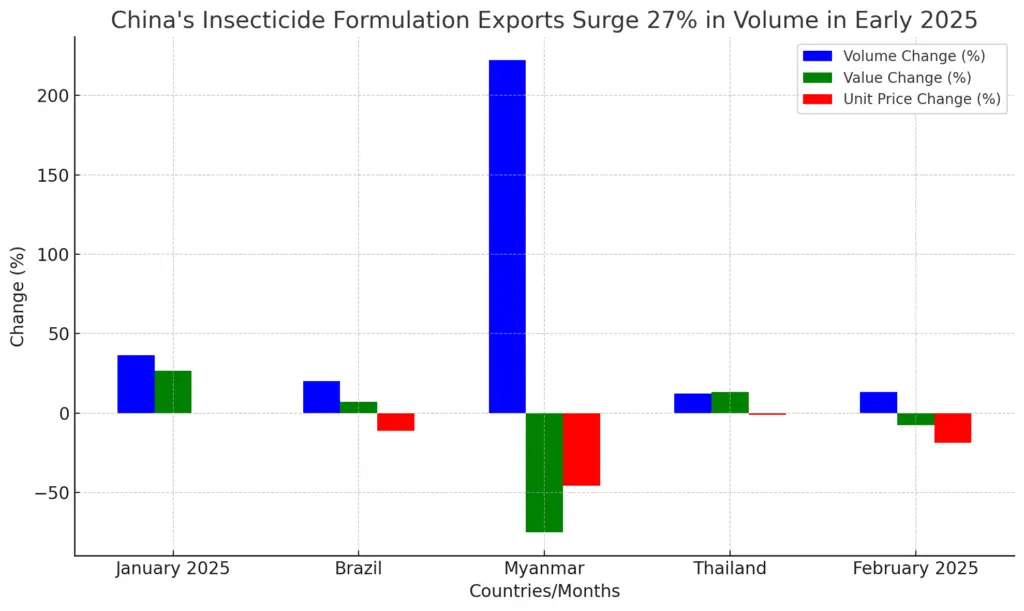
The graph based on the data provided. The chart illustrates the changes in the volume, value, and unit price of China’s insecticide formulation exports in early 2025, highlighting significant trends for January and February 2025, as well as specific markets such as Brazil, Myanmar, and Thailand.
Breakdown by Month:
- January 2025:
- Export volume surged by 36.39% YoY.
- Export value increased 26.81% YoY.
- Average unit price dropped 7.02%.
- February 2025:
- Volume rose by 13.43% YoY.
- Export value declined 7.56% YoY.
- Average unit price plummeted 18.51%.
Export Destinations:
China exported insecticides to 145 countries and regions, one more than the same period last year. The top three destination countries by volume were:
- Brazil:
- Volume up 20.27%,
- Value up 7.01%,
- Unit price down 10.99%.
- Myanmar:
- Volume skyrocketed 222.10%,
- Value dropped 74.86%,
- Unit price plunged 45.78%.
- Thailand:
- Volume up 12.23%,
- Value up 13.43%,
- Unit price down 1.14%.
All three countries, part of or influenced by the Belt and Road Initiative (BRI), have large agricultural sectors, which creates sustained demand for crop protection products like insecticides.
- Brazil is a global agricultural powerhouse (soybeans, sugarcane, corn, coffee).
- Myanmar relies heavily on rice and pulses farming, which are pest-sensitive crops.
- Thailand is a major exporter of rice, rubber, and fruits.

