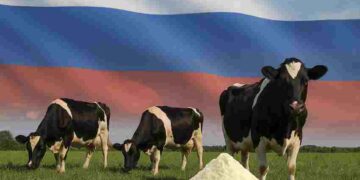





Russia’s Dairy Industry Sees Production Growth in Early 2025
According to the China Informatics, Russia’s dairy sector reported a strong performance in January–February 2025, with a combined production of 244.5 thousand tons of dry milk and whey products.
Key Dairy Segments Breakdown
- Whey (total including liquid and dry): 178.4K tons (+9.1%)
- Of which dry whey: 36.9K tons (+3.2%)
- Whole Milk Powder (WMP): 13.4K tons (+31.1%)
- Skim Milk Powder (SMP): 15.8K tons (+8.6%)
This surge was largely attributed to strong seasonal output, robust demand for protein-rich byproducts, and increasing exports, particularly toward China and Central Asia.
Consumption and Demand Dynamics
In January 2025:
- Whole milk powder consumption grew by 52.2% to 11K tons, reflecting increased demand in infant nutrition and reconstitution sectors.
- Dry whey demand fell by 6.8%, down to 17.4K tons, while
- Liquid whey consumption surged to 91.6K tons (+16.7%), indicating stronger use in animal nutrition and feed industries.
Market Perspective and Export Outlook
Russia has steadily expanded its dairy export portfolio, focusing on value-added derivatives such as milk powders and whey-based products. In 2024, Russia’s dairy export value exceeded $1.2 billion, with China, Kazakhstan, and UAE among the top importers.
Major Russian producers such as EkoNiva, Rusmolco, and Molvest are increasing investments in drying facilities and high-efficiency protein extraction technologies to compete with European exporters.
As global dairy prices remain volatile, Russia’s emphasis on whey proteins and powder exports provides strategic advantages—especially in Southeast Asia and MENA regions, where dairy import reliance remains high.

